

Dear Jane
A letter to myself.

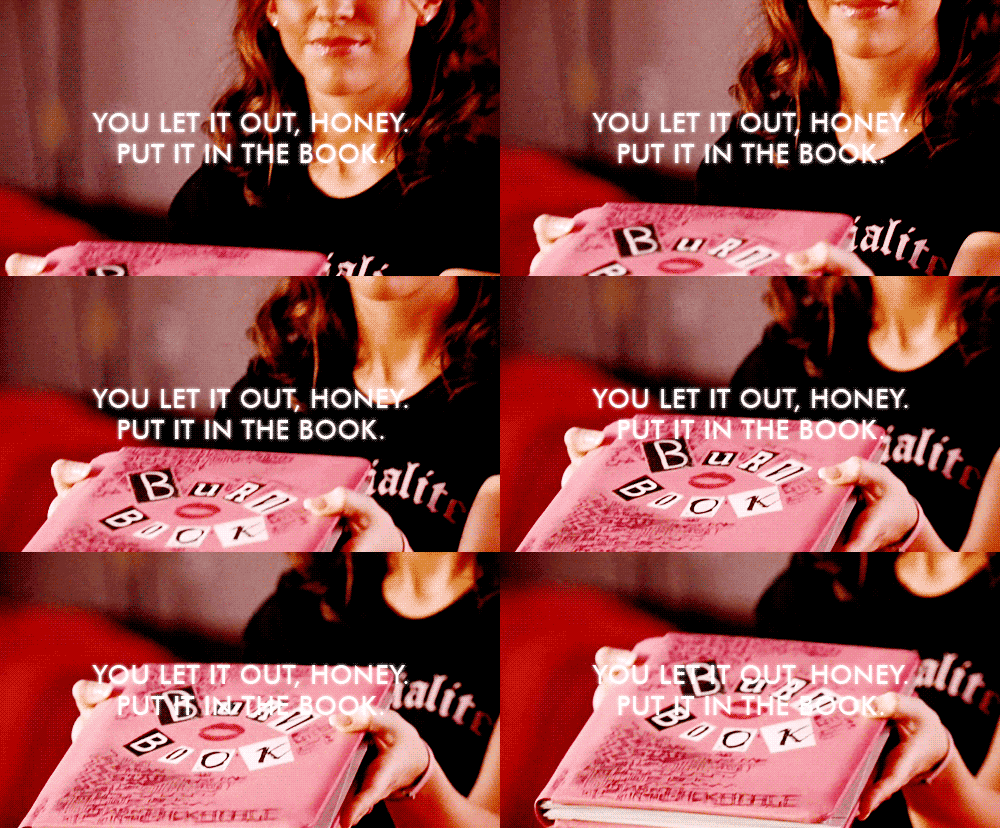
I wrote a letter to myself as though I was an expert version of myself looking back at this time and era with a little bit more of a gentle, kind lens than I typically go for. And it was something that I wrote so that I could re-read on the hard days when the mom guilt is gnawing away and the inevitable fear of failure creeps in. And, because of my chronic Overshare-itis, you get to read it too…
Dear Jane,
If you’re reading this after another chaotic bedtime that left you questioning your will to live, I want you to remember something before your brain starts telling you a story that isn’t true.
Your kids are not evidence that you’re failing.
You do not have unusually “hard” children. You are raising two girls with big personalities, which is a good thing girl. What do you want? Boring kids? Not on my watch.
You are also navigating the genuine challenges of parenthood while trying to be an incredibly intentional “good mom” - whatever that means. What even is a good mom anyways. Society said it was a French parent 8 years ago, a gentle parent 4 years ago, a “firm but fair” parent last year and, now what, a Dutch parent? Next year a good mom will be someone who hires a nanny so she can travel the Amalfi coast and post about it. Society’s definition is always changing, don’t follow the trends.
And of course it all feels hard. If it was easy, everyone would do it. It’s the hardest, most rewarding job you’ll ever accidentally (or maybe on purpose for those without a proclivity to Mai Tais) sign up to do!
Elle is intensely emotional, deeply sensitive, fiercely competitive, and strong-willed. When she’s embarrassed, disappointed, hurt, or overwhelmed, she often directs those feelings toward the safest person she knows: you. That doesn’t necessarily mean you’re doing something wrong. It means you’re her safe place.
I know, I know - that feels like a copout response. Because being a safe space often feels more like being a tiny human’s punching bag. But it’s true. You are home to her, whether you like it or not.
Ava is four.
Four-year-olds are wonderful, exhausting, opinionated little humans who are still learning how to exist in a world full of limits. She’s also growing up alongside a very big personality, and she’s figuring out who she is in that dynamic.
Then there’s you. You try so hard.
You are not just trying to keep two children alive.
You are trying to break generational cycles.
You are trying to teach emotional intelligence.
You are trying to regulate yourself while helping them regulate.
You are trying to avoid shame spirals while still creating boundaries.
You are trying to raise kind, resilient humans.
You are trying to make your kids ultra digestible to society. And you’ve got to stop that!
They are their own people. They will pave their own path.
You just need to act like bumpers in bowling - let them roll through life and keep them on track. Don’t let them fall in the gutter. They may only hit one or two pins at first but eventually they’ll get a strike.
I have a secret to tell you: one of your greatest strengths is also one of your biggest struggles: You notice everything.
The interrupting.
The whining.
The hitting.
The rude comments.
The exclusion.
The sore losing.
The disruptions.
The way your kids may differ from others.
You notice because you care deeply about who your daughters become. And you care about how people experience your children. Not because you want “perfect” kids but because you want people to see your children like you do: beautifully, imperfect, silly kids who know what they want and won’t take anything less. That, at its core, is a good thing. You care. You cannot fault yourself for that.
But you need to remember that noticing every behavior can trick you into believing every hard moment is evidence of a personal parenting failure, instead of what it usually is: A child learning a skill she hasn’t mastered yet.
You also put an enormous amount of pressure on yourself because you don’t just feel responsible for today’s behavior, you feel responsible for the adults they’ll eventually become. That’s a big cross to bear. Too heavy for one person to carry.
Your fears often get in the way of your rational mind.
When your kid is unkind, your brain doesn’t simply think,
“She was rude.”
It jumps all the way to,
“What if I’m raising someone who will always be mean?”
That is far too much pressure for one moment to carry. Development isn’t linear. Kids practice the same skills for years.
Frustration tolerance.
Impulse control.
Empathy.
Emotional regulation.
Flexibility.
Those are not skills that magically appear by a certain age.
They’re still under construction. And being refined constantly.
You also need to remember what is equally true about your girls.
They are funny.
They are adventurous.
They are affectionate.
They travel well.
They swim, expertly.
They love sports.
They make friends.
They are willing to try new things.
They love to eat. Boy do they love to eat.
They have people who adore them.
They have a mom who spends more time thinking about how to help them thrive than most.
Those things are true even on the hardest days.
The biggest challenge might not actually be that your kids are harder than everyone else’s. It may be that you hold yourself to impossibly high standards.
When your children struggle, you experience it as a reflection of you.
Every tantrum becomes evidence.
Every act of defiance becomes proof.
Every difficult transition becomes a verdict.
But those are stories, not facts.
Sure, children not listening is frustrating. But it is not a reliable measure of good parenting. If it were, every wonderful parent of a preschooler or strong-willed child would be failing.
The truth is that parenting is exhausting. And exciting. and ever-evolving.
You want to be the mom who laughs constantly, dances in the kitchen, makes vacations magical, and fills childhood with warmth. The fun mom.
But you can’t be that mom all the time.
You often act as though you have only two choices: Be the fun, playful mom. Or become a dictator.
But those aren’t the only options.
The healthiest parents are both warm and firm.
You can be silly during pillow fights.
You can be empathetic when they’re hurting.
You can be playful in the pool (good on you for always getting your hair wet, by the way!)
And when you say bedtime is bedtime, you don’t have to change my mind.
That isn’t dictatorship.
It’s predictability. Kids love predictability.
One thing you’ve learned about yourself is that you don’t struggle to know what the boundary should be. You struggle to tolerate your children’s disappointment.
Their tears make you question yourself.
Their anger makes you want to negotiate.
Their protests make you explain, warn, and give one more chance.
Not because you don’t believe in boundaries. Because you care so deeply about your relationship that conflict feels almost unbearable. Or that the path of least resistance feels easier, in the moment. But children don’t need you to rescue them from every uncomfortable feeling. They need you to stay with them while they experience those feelings.
Remember this:
You don’t have to make everyone happy. That is not your job.
You don’t have to make everything perfectly fair. That is not your job.
You don’t have to avoid tears at all costs. That is not your job.
You just have to be the calm adult in the room. Easier said than done, I know, but at least it’s one, tangible trait to work towards. An unregulated parent cannot regular an unregulated child.
You also need to remember something incredibly important: When your children have big feelings, it does not automatically mean you’ve done something wrong.
Their emotions are not your report card.
Parenting is measured over years, not evenings.
So the next time you find myself thinking,
“My kids don’t listen because I’m a bad mom,”
Replace it with something truer:
I’m raising two children with developing brains.
I’m learning right alongside them. This is my first rodeo too.
Their hard moments are not proof of my failure.
Most importantly, stop making bedtime, sibling fights, and every moment of defiance into a referendum on your identity.
You don’t need perfect children to be a good mother.
You don’t need children who always listen to be worthy.
You don’t need to become a dictator to raise kind, respectful humans.
You can be warm.
You can be playful.
You can be deeply connected.
And you can calmly hold boundaries.
Those things are not opposites. They are actually very complimentary.
And on the nights when you forget all of this, I hope you come back and read these words again.
Because you children are still learning.
As so are you.
Now stop doom scrolling and get to bed, bitch. Tomorrow is a new day.
I felt like I was reading my own words (besides getting my hair wet in the pool lol). I feel this deeply, Jane. Thank you for putting it into words so eloquently.
Loved this!